 English
 Arabic

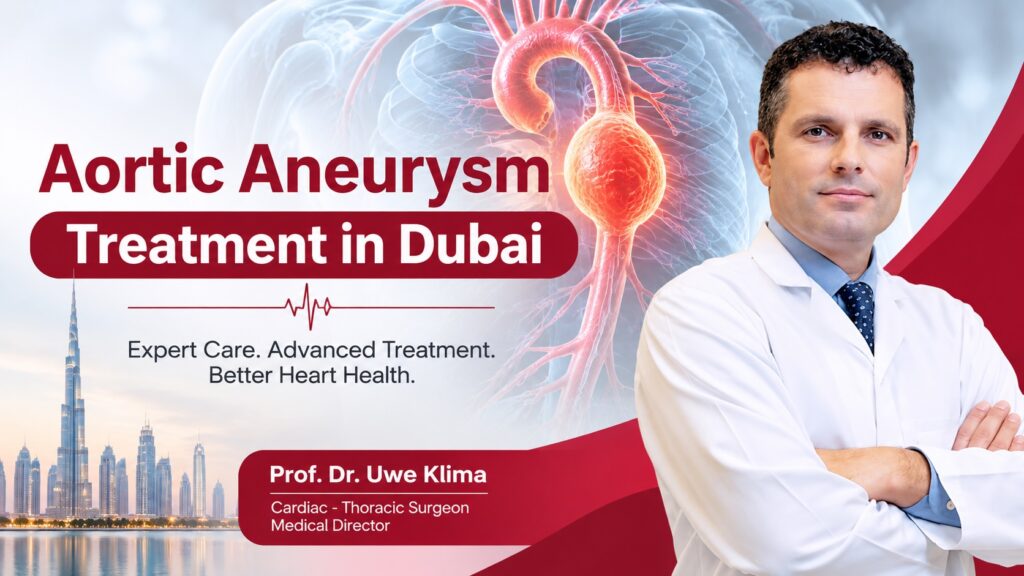
Some health problems announce themselves loudly. An aneurysm usually doesn’t. Most people who have one feel perfectly normal right up until the day it’s discovered, either by chance on a scan or, in the worst cases, because it has torn or burst.
That’s why aneurysms deserve more attention than they usually get. If you or someone in your family has been told about a widened artery, or you’re simply curious about aneurysm treatment in Dubai and the UAE, this guide covers what an aneurysm is, who’s at risk and how it’s managed.
What Is an Aneurysm?
An aneurysm is a bulge in the wall of an artery, caused by weakening of the vessel wall. Think of a weak spot in a garden hose that balloons outwards under pressure. The larger it grows, the thinner the wall becomes and the greater the risk that it splits.
The aorta, the body’s main artery, is the most important place for this to happen. Aortic aneurysms are described by location:
- Thoracic aortic aneurysm, in the chest part of the aorta, including the section leaving the heart (the ascending aorta) and the arch
- Abdominal aortic aneurysm, in the part running through the abdomen
Aneurysms can also occur in other arteries, including those in the brain, but this article focuses on the aorta, which is the territory of cardiac-thoracic and vascular surgeons.
Who Is at Risk?
Several factors can weaken the aortic wall or raise the pressure on it:
- High blood pressure, which is the most common contributor
- Smoking
- Age, since risk rises over the years
- Family history of aneurysm or sudden aortic problems
- Inherited connective tissue conditions, such as Marfan syndrome
- A bicuspid aortic valve, a valve with two leaflets instead of three
- Atherosclerosis, the build-up of fatty deposits in arteries
- Previous chest injury or certain infections
Keeping blood pressure under control matters a lot. If yours runs high, see our page on hypertension treatment, and take a look at our article on high blood pressure symptoms you shouldn’t ignore.
Symptoms: Usually None, Until They Are Serious
Most aneurysms cause no symptoms. When they do, they might produce:
- A deep, persistent pain in the chest, back or abdomen
- Hoarseness or difficulty swallowing, from pressure on nearby structures
- A pulsing sensation in the abdomen
Sudden, severe, tearing chest or back pain, especially with fainting, sweating or breathlessness, is an emergency. It may mean the aorta has torn (a dissection) or ruptured. Call emergency services straight away rather than waiting.
How Aneurysms Are Found
Because they’re silent, aneurysms are frequently discovered by accident, on a scan done for another reason. Doctors confirm and measure them with echocardiography, CT scanning or MRI. Your cardiologist may arrange screening if you have a strong family history, a connective tissue disorder or a bicuspid valve. Regular checks at our cardiology clinic can pick up warning signs earlier, and our high-risk care packages are designed with people at elevated risk in mind.
Watch, Treat or Operate?
Not every aneurysm needs surgery. Treatment depends mainly on size, location, growth rate, your symptoms and your general health.
Watchful waiting. Small aneurysms are usually monitored with regular imaging, together with blood pressure control, cholesterol management and stopping smoking. Medication is used to reduce the stress on the aortic wall.
Surgery. When an aneurysm reaches a size where the risk of rupture outweighs the risk of an operation, repair is recommended. Guidelines often use a diameter of roughly 5.5 cm for the ascending aorta, but the threshold can be lower for people with Marfan syndrome, a bicuspid valve, a family history of dissection or rapid growth. Your surgeon will personalise that number to you.
Repair options include:
- Open surgical repair, where the weakened section of aorta is replaced with a synthetic graft. If the aortic valve is involved, the valve may need repair or replacement at the same time.
- Endovascular repair, where a stent graft is placed through the blood vessels without opening the chest, suitable only for certain anatomies.
Which option is better depends on where the aneurysm is and what your anatomy allows. Aortic surgery is complex, so it should be planned by a team experienced in both the heart and the great vessels. Our cardiac surgery and thoracic and vascular surgery services both cover this territory.
Living With an Aneurysm
If you’ve been told you have a small aneurysm, you’re not helpless. Take your medicines, keep blood pressure in range, avoid smoking, and don’t skip your imaging appointments. Ask your doctor about heavy lifting and extreme straining, which can raise pressure temporarily. And tell close relatives, since some aneurysms run in families and relatives may benefit from screening.
World Class Cardiac Care with German Expertise in Dubai
Aortic disease sits where heart care, vascular care and surgery meet, so the quality of coordination matters. World class cardiac care with German expertise in Dubai means your imaging, risk assessment and surgical planning are reviewed together, with a clear rationale for waiting or operating. If you’d like a second opinion on a scan result, we welcome that.
German Specialties in UAE
The German specialties in UAE that we focus on in aortic care are careful surveillance and well-timed intervention. Operating too late is dangerous. Operating too early exposes you to risk you don’t need. Judging that balance, using your own measurements and risk factors, is the heart of the work.
Your Surgeon: Prof. Dr. Uwe Klima
Aneurysm surgery is among the specialty interests of Prof. Dr. Uwe Klima (MD, PhD), German Board Certified Cardiac-Thoracic Surgeon and Medical Director at GHC. He has a medical degree from the University of Vienna and a PhD from Hannover Medical School, and he trained at Massachusetts General Hospital and Harvard Medical School. He has co-authored more than 300 peer-reviewed articles and performed over 150,000 surgical procedures. He operates at affiliated hospitals in Dubai and also provides second opinions. Visit his profile.
Frequently Asked Questions
1. Can an aneurysm go away on its own?
No. Aneurysms don’t shrink by themselves. Many stay small and stable for years with monitoring and good risk-factor control, while others grow and need repair.
2. Is aneurysm surgery safe?
Planned (elective) repair is generally much safer than an emergency operation after rupture. Your individual risk depends on your age, heart and lung function and the location of the aneurysm.
3. Should my family be screened?
If a close relative has had an aortic aneurysm or dissection, or you have a connective tissue condition, talk to a cardiologist about screening.
4. Book a Consultation
If you have a known aneurysm, a worrying scan or a strong family history, don’t leave it to chance. Call GHC on +971 4 362 4797 or contact our team. For sudden severe chest or back pain, use our emergency contacts or call emergency services at once.