 English
 Arabic

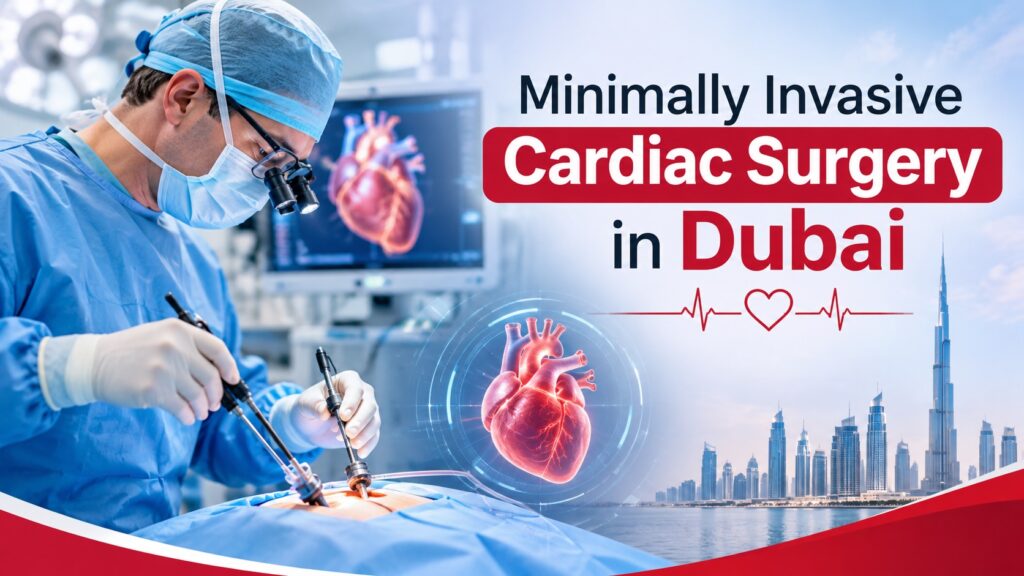
Say “heart surgery” and most people picture a long scar down the chest and weeks of lying flat. For some operations, that picture is out of date. Minimally invasive cardiac surgery in Dubai now lets surgeons reach the heart through much smaller openings, and for the right patient that can mean less pain, less blood loss and a quicker return to normal life.
But “minimally invasive” doesn’t mean “minor”. It’s still heart surgery. It needs an experienced surgeon, a careful plan and an honest answer to one question: is this the best option for you? Here’s how we explain it to patients at German Heart Centre (GHC) in Dubai Healthcare City.
What Is Minimally Invasive Cardiac Surgery?
Traditional open-heart surgery usually involves a sternotomy, where the breastbone is divided so the surgeon has a full view of the heart. Minimally invasive approaches reach the same target through smaller incisions, often just a few centimetres wide between the ribs. Surgeons may use a small camera and long, specially designed instruments. In many cases the breastbone stays intact.
That last part matters more than the scar. A whole breastbone generally means less pain, fewer wound problems and, for many people, an easier first few weeks at home.
Which Heart Problems Can Be Treated This Way?
It depends on the patient and the anatomy, but a minimally invasive route may be considered for:
- Mitral valve repair or replacement
- Selected aortic valve operations
- Some coronary bypass procedures
- Closure of atrial septal defects (a “hole in the heart”)
- Removal of certain cardiac tumours
- Surgical treatment of atrial fibrillation
Not everyone is a candidate. Previous chest surgery, heavily calcified vessels, certain body shapes or an emergency situation can all point towards a conventional approach. A good surgeon will tell you that plainly, even if you’d hoped for the smaller incision.
The Benefits, and the Honest Limits
Patients who are suitable candidates often notice:
- Less pain after the operation
- Smaller, less noticeable scars
- Less blood loss, so a lower chance of needing a transfusion
- A lower risk of infection around the breastbone
- A faster return to walking, driving and work
Now the other side. These operations can take longer, and they demand specialised training and equipment. In some situations, open surgery gives the surgeon better access and a safer result. Safety always comes before scar size.
What to Expect: Before, During and After
Before surgery. You’ll have a full assessment: a heart tracing (ECG), an echocardiogram, blood tests and often a CT scan to map your vessels. This is where the surgeon decides whether a keyhole approach is realistic.
During surgery. You’ll be under general anaesthetic. The surgeon works through the small chest incision. For many valve operations, the heart-lung machine is connected through blood vessels in the groin or neck rather than through a large chest opening.
After surgery. Most patients spend the first day or so in intensive care, then move to a ward. We get people up and walking early. Recovery speed varies a lot from person to person, so your surgeon will give you a plan that fits your age, your health and your job.
German Specialties in UAE
People often ask what “German” really means in a clinic. For us it’s practical rather than a slogan. It means structured care pathways, a thorough assessment before any operation, a habit of checking the evidence, and surgeons trained in the German system. These German specialties in UAE healthcare come down to one simple idea: do what’s needed and skip what isn’t. GHC has worked this way in Dubai since May 2006, and our team is committed to minimising unnecessary tests and treatments.
World Class Cardiac Care with German Expertise in Dubai
When we talk about world class cardiac care with German expertise in Dubai, we mean the whole journey, not just the operating theatre. Your cardiologist, surgeon and follow-up team work from the same information. If your heart problem can be managed without surgery, you’ll hear that. If it can’t, you’ll know why. You also get a surgeon who is happy to explain things in English or German, and who isn’t rushed when you ask the same question twice.
Meet Prof. Dr. Uwe Klima
Every surgical speciality at GHC is led by Prof. Dr. Uwe Klima (MD, PhD), a German Board Certified Cardiac-Thoracic Surgeon. He studied medicine at the University of Vienna, earned his PhD at Hannover Medical School and trained at institutions including Massachusetts General Hospital and Harvard Medical School. He has co-authored more than 300 peer-reviewed articles and has performed over 150,000 surgical procedures. Minimally invasive cardiac surgery is one of his listed specialty interests, alongside valve repair and complex cardiac and thoracic surgery. He performs advanced procedures at affiliated hospitals in Dubai and also offers second opinions to patients weighing up invasive surgery. Read his full profile here.
Frequently Asked Questions
1. Is minimally invasive heart surgery safe?
For well-selected patients, in experienced hands, it’s an established option. The key phrase is “well-selected”. Your surgeon will compare the benefits with the risks for your particular heart before recommending it.
2. How long is the recovery?
It varies. Many people leave hospital within about a week and return to light activity within a few weeks, but your age, general health and the type of operation all play a part. Don’t compare yourself with a friend’s timeline.
3. Does insurance cover cardiac surgery in Dubai?
Coverage depends on your plan. GHC works with a number of insurers, and you can check our insurance network page or ask our team before you book.
4. Thinking About Cardiac Surgery? Start With a Conversation
If you’ve been told you need heart surgery, or you simply want a second opinion, you don’t have to decide alone. Our cardiac surgery service starts with listening to your story and reviewing your tests. Call GHC on +971 4 362 4797 or reach out to us online. If you’re having chest pain right now, don’t wait for an appointment. Use our emergency contacts or call emergency services immediately.